WHEN AI TAKES SHAPE IN THE FORM OF INTELLIGENT AND COGNITIVE ROBOTS

23 October 2025 | 11.15h to 12.15h

Intelligent and cognitive robotics is one of the most tangible and advanced expressions of applied artificial intelligence. When AI ‘takes shape’ in the form of robots capable of perceiving, reasoning and acting, new possibilities open up to transform sectors such as industry, health, logistics, personal care and even precision agriculture. In this session, we will explore real cases, innovative projects and technological challenges that bring us closer to a future where machines and humans work together more intelligently, autonomously and safely.

Presents:

  • Simona Neri, Innovation Manager, AI&Robotics Department, Eurecat

Participate:

  • Llum Fuster, AI Engineer, OmniAccess. Project developed at the Institute of Robotics and Industrial Informatics (IRII)

  • Sergi de las Muelas, Robotics Engineer, Pal Robotics

  • Néstor García, Head of Robotics Manipulation, Eurecat

Presents

SIMONA NERI

Innovation Manager, AI&Robotics Department, Eurecat

Simona Neri is AI & Robotics Innovation Manager at Eurecat, with over 10 years of experience at the nexus of advanced research, industrial practice, and strategic innovation. She holds a PhD in Nanotechnology and an MBA, and has worked at global companies such as P&G and GSK. At Eurecat, she leads European R&D projects in robotics, AI, and advanced manufacturing, with a focus on human-robot collaboration, ergonomic automation, and rapid robot learning. Simona actively contributes to policy-technology dialogue, supports knowledge transfer, and builds interdisciplinary consortia that deliver real-world impact in digital transformation and sustainable industrial practices.

Speakers

LLUM FUSTER

AI Engineer, OmniAccess. Project developed at the Institute of Robotics and Industrial Informatics (IRII)

Llum Fuster Palà graduated as part of the first cohort of the Bachelor’s Degree in Artificial Intelligence at the Polytechnic University of Catalonia in 2025. She has worked as an Artificial Intelligence Engineer at Omniaccess since July 2023. During this time, she also completed an AI Intern placement at the IRI – Institute of Robotics and Industrial Informatics, where she developed her Bachelor’s Final Project focused on negotiating scheduling plans in human–robot teams (September 2024 – April 2025).

Negotiation of Assignation Plans in Human-Robot Team Task Scheduling

Can you imagine a future where humans and robots coexist in the world?
The field of human–robot interaction aims to enhance robotic systems in order to develop more autonomous robots capable of operating collaboratively with humans. The challenge we pose involves the allocation of tasks between two workers—one human and one robot; both must collaborate to reach an agreement on the division of labor. We propose an innovative negotiation framework that integrates automated planning and natural language processing to create a negotiation system able to arrive at a task‐allocation agreement with a human partner. Based on the description of tasks, preferences, and constraints—and through an alternating‐offer negotiation protocol—the robot and the user collaborate to produce a plan optimized both in terms of individual effort and group efficiency. The system has been implemented on a real robot and validated in a user study with 28 participants, demonstrating that iterative negotiation increases perceived fairness, efficiency, and adaptability compared to a unilateral assignment model.

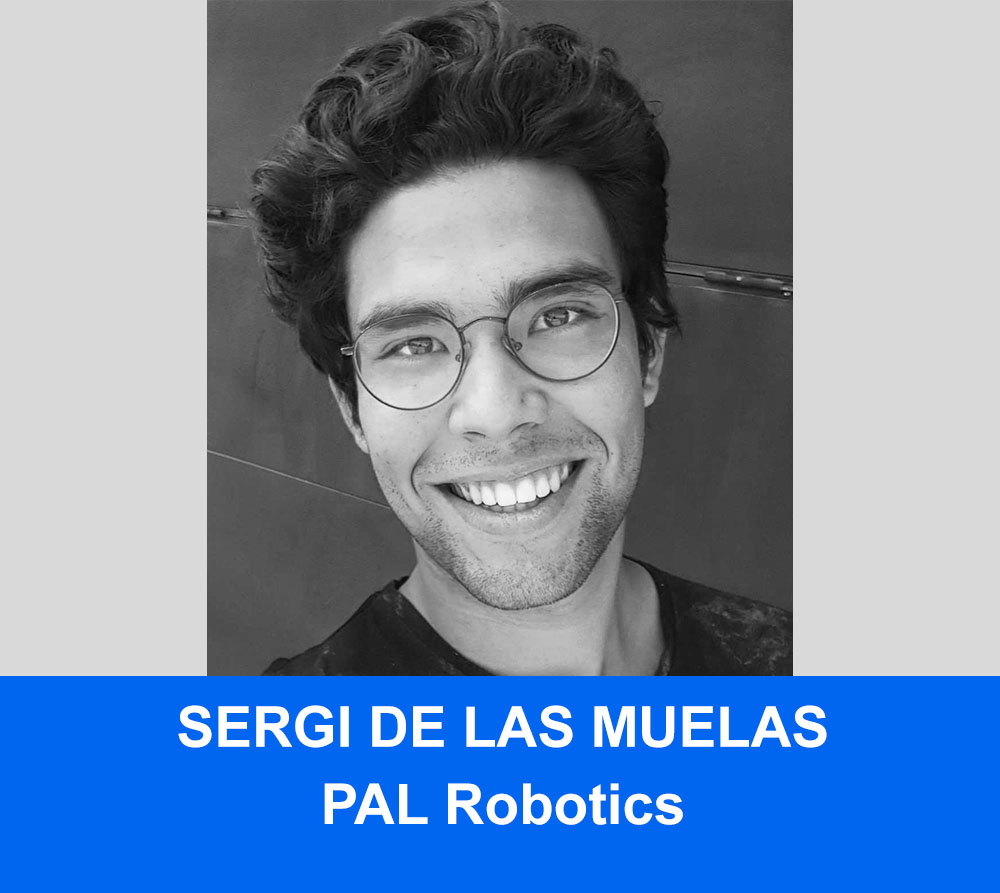
SERGI DE LAS MUELAS

Robotics Engineer, PAL Robotics

Sergi de las Muelas graduated in Mechatronics Engineering from the University of Vic (UVic), completed a Master’s degree in Control and Robotics from the Polytechnic University of Catalonia (UPC), and is currently pursuing a PhD in advanced control techniques for humanoid robotics. He is an Associate Professor of Mobile Robotics at UVic, coordinator of a university robotics team, and an engineer at PAL Robotics, where he has two years of experience developing and executing Reinforcement Learning projects in the field of bipedal locomotion.

AI in PAL Robots

This presentation explores how artificial intelligence is driving the development of humanoid robotics. The most commonly used techniques will be discussed and where they fit within robots, showing how these tools enable more adaptive, safe, and collaborative robots. The presentation will reflect on the potential of these technologies to improve everyday life, support complex tasks, and expand human capabilities, defending the idea that humanoid robotics with AI should be seen as an ally, not a threat.

NÉSTOR GARCÍA

Head of Robotics Manipulation, Eurecat

Received the B.S. degree (with honors) in Industrial Engineering and the Ph.D. degree (also with honors) in Automatic Control, Robotics and Computer Vision, both from the “Universitat Politècnica de Catalunya” (UPC), Barcelona, Spain, in 2015 and 2019 respectively. He worked as a Research Assistant at the Institute of Industrial and Control Engineering (IOC) of the UPC, being involved in different R&D projects. He joined Eurecat in 2018, where he is the Head of the Robotics Manipulation research group. His current research interests are focused on robot skill learning, dexterous manipulation, human-robot collaboration, and advanced manufacturing.

Intelligent robots in action: Challenges and learnings from real-world scenarios

Intelligent and cognitive robotics represents one of the most tangible and advanced expressions of applied artificial intelligence. When AI “takes shape” in the form of robots capable of perceiving, reasoning, and acting, new opportunities emerge to transform sectors such as industry, healthcare, logistics, caregiving, and even precision agriculture. In this session, we will explore real-world cases, innovative projects, and technological challenges that bring us closer to a future where machines and humans collaborate in a more intelligent, autonomous, and safe way.